

Our Blog

Volunteer
Helene was an Act of Nature. Our volunteering is an Act of God.
When Storm Helene created disaster zones in both North and South Carolina, LDR Carolinas received generous donations from across the country and grant funding from Lutheran Disaster Response to serve the impacted communities.
18 Months
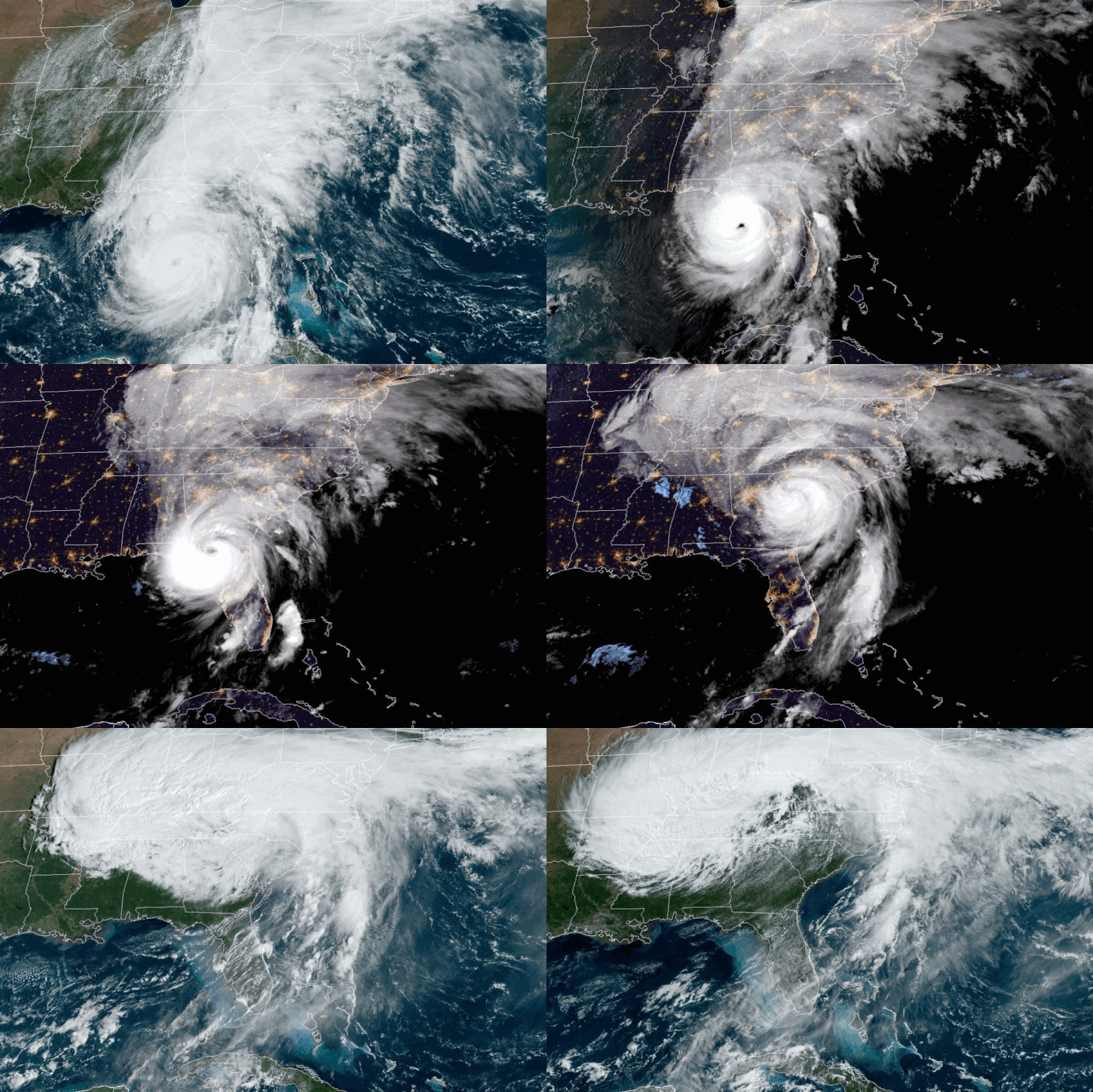
It has been 18 months since Helene devastated large portions of the southeast in late September 2024. Our team is still at work here in the Carolinas – in fact, the team has recently grown – as we continue our work in long-term recovery. More information about our team members Amy, Kelli, Heather, Jonathan, and Thom is available here on our website.
The prayers for worship on Sunday, March 22 from Sundays and Seasons (© 2026 Augsburg Fortress) included a petition for God to “prosper the work of those who restore homes and habitats after natural disasters.” This is a good time for an update on our work and how you can help it prosper!
ALL of our work is done with the support of Lutheran Disaster Response and in partnership with the North Carolina Synod and South Carolina Synod of the ELCA. Much of our work is done in partnership with other organizations, especially those who also belong to VOAD (Voluntary Organizations Active in Disaster).
We are still replacing private bridges in western North Carolina through the Bridging Together partnership with Mennonite Disaster Service. We have completed more than 30 bridges so far, helping over 65 families return home safely each day. That work is supported largely by grants from the American Red Cross and the Community Foundation of Western North Carolina. Contact Ray for more information about Bridging Together.
We have been organizing the Lakelands LTRG (Long-Term Recovery Group) in six heavily impacted counties (Greenwood, Edgefield, Abbeville, McCormick, Newberry, and Saluda) in South Carolina, with grant support from American Red Cross. Kelli has been leading this work. Throughout that process we have been working collaboratively with other organizations including Convoy of Hope, Lutheran Services Carolinas, and the Salvation Army. We will soon be turning fiscal management of the LTRG over to Lakelands United Way, so that they can continue to support recovery in their community, while we widen our focus to include other impacted areas.
With special grant funding, we have provided propane tanks for distribution through the Faith360 Network, a ministry of ABCCM (Asheville Buncombe Community Christian Ministry) to those in need of heating assistance in WNC. Disaster Case Managers can apply directly to Faith360 for those tanks while supplies last.
We have also received grant funding to support community ministries providing food and heating assistance in WNC. Contact Heather if you would like to suggest a specific ministry to receive assistance.
We continue to coordinate the work of volunteers in both North and South Carolina as they repair homes, clean up debris, and support feeding ministries. Over 1000 volunteers worked with us in WNC last year! Read more about the work of those volunteers here. That work includes partnerships with LTRGs and other organizations in many impacted counties in both states. A key partner in North Carolina is NovusWay, as many of our volunteer teams stay at their camps, Lutheridge and Lutherock. Talk with Amy for more information.
In addition to the work of recovery, we continue the work of preparedness. We would be glad to visit your congregation to talk about household and congregational preparedness, as well as the ongoing work of LDR Carolinas. Contact Ruth Ann to schedule a visit! Amy has also been working to adapt an existing LDR resource Preparedness in a Year, which breaks down the process into manageable monthly steps to help families prepare at home. She is beginning monthly sessions in WNC. Look for more information coming soon.
We thank you for the support you have already shared and invite you to continue to help prosper this ongoing work!
Your financial support, volunteer work, and donations of needed items will help us to keep doing this work as long as there is a need. Here are some ways to help:
Send financial support to LDR Carolinas at 1988 Lutheran Synod Drive, Salisbury NC 28144 or give online here (select LDR Carolinas in the drop-down box).
Another way to provide financial support is by sending us gift cards for Lowe’s, Home Depot, Walmart, and Amazon. We use those to purchase needed supplies, tools, and building materials to support the work of volunteers.
More information about volunteering in both North and South Carolina is available here.
We are also accepting some donated items, although our storage space is limited. NC Lutheran Men in Mission recently donated a shipping container for us to use as a tool shed. Now we need tools to fill it. Sign up to donate needed tools.
We distribute children’s comfort kits at local events and handmade quilts as welcome home gifts at bridge dedications and when home repairs are complete. We also hope to have a supply of cleanup kits (flood buckets) available before the next disaster impacts the Carolinas. Information on these kits is available here. Because our storage space is limited, please contact Ruth Ann before shipping any items to us.
Join us for our next LDR Carolinas Network Meeting Tuesday April 21 at 7 pm on Zoom for more updates! Contact Ray for the meeting link.
Mental, Emotional, and Spiritual Support (MESS) Training May 2026
Mental, Emotional, and Spiritual Support (MESS) Training
May 18-20, 2026 at Coastal Retreat Center
2101 Palm Blvd, Isle of Palms, SC 29451
Monday, May 18 from 1-6:30 pm | Tuesday, May 19 from 8:30-5:30 pm | Wednesday, May 20 from 8:30-12:30 pm Attendees must be available for all training times to attend – Lodging is provided at Coastal Retreat Center.
Course Description
MESS training is an interfaith skills-based disaster program designed for clergy, lay leaders and community responders – people who may encounter and provide care for individuals in crisis or distress from conventional disasters or disasters of everyday life. This skill-based training helps equip the community to care for one another in times of crisis.
Attendees will learn to confidently support individuals facing mental, emotional, and spiritual distress using a 6-Part Protocol rooted in compassion, curiosity, and connection. This highly interactive course equips participants with practical skills for both supportive conversations and crisis stabilization—without the pressure to “fix” or offer quick solutions. No prior experience is required. Participants only need an empathetic spirit and a desire to walk alongside those who are hurting. This training is offered in partnership with MESS Ministries, Inc., the creators of the 6-Part Protocol.
Attendees will Learn
- To Show Up with compassionate, guiding presence.
- To Lean In with deep listening, appropriate asking, and further exploration.
- To Listen Out to identify immediate needs and critical concerns.
- To Provide Care through crisis stabilization or supportive acceptance and empowering action.
- To Kindle Hope by encouraging perseverance and inspiriting possibility.
- To Follow Up through planning and/or refer to next-level care.
Course Logistics and Registration
- Duration: 2.5 Days (20 hours)
- Format: In-person at Coastal Retreat Center
- Cost: As a part of Lutheran Disaster Response’s training support, there is no-cost to the community
- For Information: Contact Pastor Ruth Ann Sipe at ruthann@ldrcarolinas.org
- To register: Visit this link or use the QR code:
November News
What is the LDR Carolinas Network?
The purpose of the network is to connect individuals and congregations in NC & SC who are prepared to respond to disaster. We use the network to help connect with volunteers, identify meeting locations, and find other support for LDR Carolinas projects.
During network meetings we provide updates on recovery, information on current needs, and invitations for network members to participate in volunteer projects and training opportunities. We also answer your questions about the work of LDR Carolinas!
Join the LDR Carolinas network to receive invitations to our meetings plus information from us directly via email.
Volunteers are needed in both NC & SC to assist with recovery from Hurricane Helene!

These are some of the current projects in SC where we need volunteers. Many of these are one day projects.
Leesville: Installing underpinning at a mobile home
Little Mountain: Roof repairs, debris cleanup from projects, helping contractors with projects
Newberry: Assist with tear out and rebuilding for a mold remediation project. This includes helping a contractor with basic cleanup and hauling off debris.
LDRC will provide needed materials, tools, ladders, gloves, masks, etc. for these projects. Contact Kelli Fulmer for more information.
There are also numerous projects where volunteers are needed in WNC. Volunteer housing can be arranged. Contact Amy Phillips for more information.
More information about volunteering is available on the Volunteer tab on our website!
Bridging Together
Our partnership with MDS (Mennonite Disaster Service) has completed eleven bridges and other projects to date. Work is ongoing now, with a break planned during December. Work will begin again after the first of the year, with many more bridges planned during the next year!
We have approximately $7 million grant funding to provide for materials, engineering, and permits.
Here is a link to a news report from a recently completed bridge: Candler Bridge rebuilt after Helene, dedicated in memory of a local man’s daughter
Volunteers for bridges must register through MDS. Contact Ray for details on volunteering or other information on bridges!
Ongoing Projects and Donations Needed

Financial donations are always gratefully received, but there are also some items that are helpful during long-term recovery:
• Lowe’s, Home Depot, Walmart, Amazon, or Visa gift cards are always welcome. We use them to purchase tools, building materials, and supplies.
• Walmart or Ingle’s gift cards which can be given to families to purchase groceries are also welcomed. Ingle’s is the most common grocery store in small towns in WNC. We have plenty of Food Lion cards on hand.
• Quilts are needed, but in small quantities because we have limited storage space. Please contact Amy or Ruth Ann before sending those to us.
If you want to help be prepared for future disasters, please assemble Cleanup Kits (aka flood buckets). The instructions are available here. Because we have limited storage space, it would be best if you can store them until they are needed, but please let us know that you have them ready, so we will know where they are located when they are need
Join us for another study of A Ready Hope!

The six-session study will meet Thursday evenings January 8 to February 12, 2026 at 7:00 p.m. on Zoom.
Register here to receive a copy of the book for your congregation as well as the link for the study on Zoom.
“Disaster recovery work is very much God-work. The role of responders is to be open to letting God decide when and where and how our services are needed.”
From A Ready Hope by Haueisen & Flores
Congregational Preparedness Workshops are being planned for early 2026.

January 31 Our Father, Greensboro NC
March 7 Trinity, Rocky Mount NC
Other locations and dates are being scheduled now.
We are also looking for a location in Upstate SC.
Look for registration information coming soon!
Save the Date for MESS (Mental, Emotional, and Spiritual Support) Training!
The next course will be May 18-20, 2026 at SC Coastal Retreat Center, Isle of Palms SC. Look for registration information soon!
Please mark your calendar now and plan to join us for our next LDR Carolinas Network meeting on Thursday, February 19!